One hand, many traditions
The word hamsa comes from the Semitic root for "five" — khamsa in Arabic, hamesh in Hebrew — a straightforward reference to the five fingers of the open hand. The symbol itself is older than either name. Open-hand amulets appear in the ancient North African and Levantine world, including in Carthaginian artifacts associated with the goddess Tanit, centuries before the traditions that carry the symbol today.
In Islamic cultures, particularly across North Africa and the Middle East, the hand is often called the Hand of Fatima, after Fatima, daughter of the Prophet Muhammad. In Jewish communities — especially Sephardi and Mizrahi communities of the same regions — it is the Hand of Miriam, after the sister of Moses and Aaron. Both traditions use it the same way: as an amulet of protection, particularly against the evil eye, the envious gaze believed to bring misfortune.
That shared use across neighboring faiths is part of the hamsa's appeal. It is one of the rare symbols that Jewish and Muslim communities of the Maghreb and the Levant wore side by side, and it remains common in both today, as well as in secular fashion far beyond either. Wearing one does not require membership in any tradition, but it rewards knowing where it comes from.
Fingers up or fingers down
Most hamsa pendants hang one of two ways, and tradition assigns each orientation a meaning.
Fingers pointing up is the warding position. The raised open hand is a universal stop gesture, and worn this way the hamsa is understood as active protection — a shield against the evil eye and ill intent. This is the older and more common amulet orientation.
Fingers pointing down is the receiving position. A downturned hand suggests offering and openness, and this orientation is associated with welcoming blessings, abundance, and good fortune into the wearer's life. Some also read it as a gentler, more meditative posture than the upraised shield.
Neither is wrong. These are folk interpretations that vary by region and family, not doctrine, and many hamsas — including pieces with a fixed bail — commit to one orientation by design. If the distinction matters to you, check how a specific pendant hangs before buying; if it does not, choose the design you find beautiful and let the symbol do what it has always done.
Many hamsas also carry an eye in the center of the palm. This is the evil eye motif turned defensive: the watching eye that reflects the harmful gaze back at its source.
The pave diamond hamsa
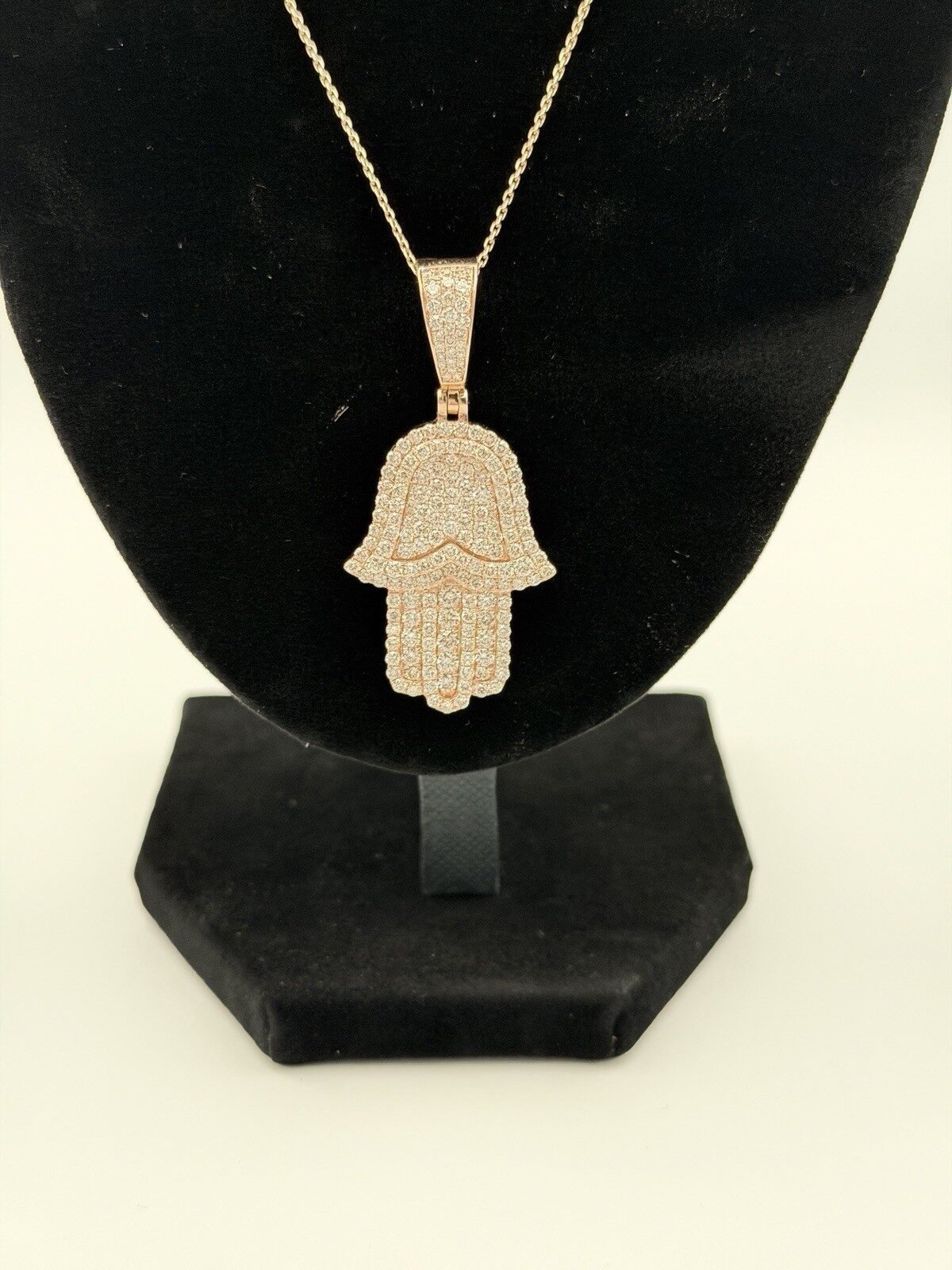
The hamsa's flat, symmetrical silhouette makes it an unusually good canvas for pavé setting — the technique of covering a surface with small diamonds set closely into drilled seats, each held by tiny beads of metal raised from the surrounding gold. Done well, the metal nearly disappears and the whole hand reads as a continuous field of light.
With pavé pieces, the details worth checking are the ones that determine how the piece lives on a chain. Look at the back: an open gallery lets skin oils rinse out and keeps the piece comfortable. Look at the bead work under magnification or in close photographs — even, consistent beads hold stones securely for decades. And weigh the total carat spread against the size of the hand; a generous spread across a palm-sized pendant produces the lit-from-within effect that makes pavé hamsas so photogenic.
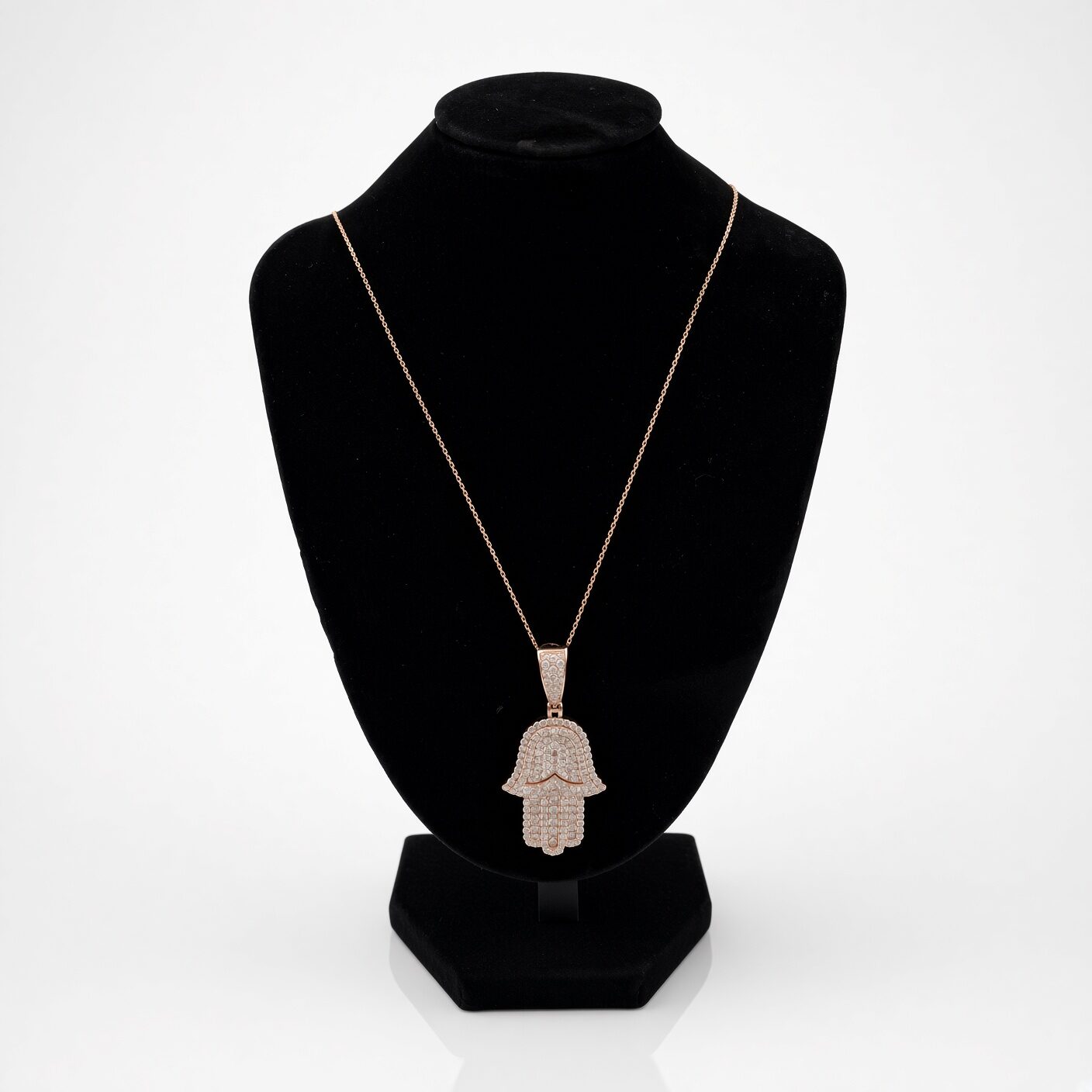
Our 14k rose gold diamond hamsa pendant carries three carats of natural diamonds across the hand. The rose gold is a deliberate choice: the warm metal reads through the pavé and gives the piece a blush glow that white gold pavé, for all its iciness, does not have. As with everything we sell, it is photographed as-is and weighed on a calibrated scale.
Pairing the pendant with the right chain
A pendant is only half the necklace. The chain determines how the hamsa sits, how it survives daily wear, and how the whole piece reads.
Weight comes first. The chain should outweigh the failure point, not the pendant. A substantial pavé pendant on a delicate cable chain is a broken chain waiting to happen. As a rule, choose a chain whose links are robust enough that you would trust them to hold the pendant swinging freely — a solid 2mm-and-up chain for a serious pendant, heavier for a heavier hand.
Franco is the workhorse. A solid franco chain is among the best pendant chains made: its interlocked four-sided weave distributes stress across the whole link structure rather than concentrating it at single solder joints, it lies flat, and it resists kinking. A 3.5mm franco carries a large hamsa without visual competition.
Ball chain is the quiet option. A solid ball chain reads as a row of points of light, which pairs naturally with pavé — the beads echo the diamond beadwork. At 16 inches it sits the pendant high on the chest, a deliberate, close-worn look.
Length sets the stage. 16 inches sits at the collarbone, 18–20 inches drops the pendant onto the upper chest where most hamsas look their best, and 22-plus inches suits layering under other pieces.
Wearing it well
Because the hamsa carries real meaning in living traditions, some buyers ask whether wearing one respectfully requires anything in particular. The honest answer: the hamsa has been shared across cultures and worn as both amulet and ornament for centuries, and there is no tradition that restricts it to initiates. Knowing its history — which you now do — is the respect the symbol asks for.
Practically, a gold hamsa is low-maintenance. Wipe it down occasionally, wash pavé gently with warm water and mild soap, and store it on its chain or in a pouch where the diamonds cannot scratch softer pieces. Gold and natural diamonds do not fade, plate, or wear through; a solid piece worn daily for years needs only cleaning.
If you are looking for one, our pieces are one-of-each — when a pendant sells, it is gone. See what is currently available in the shop, or enquire directly for weights, dimensions, and additional photographs of any piece. Orange County buyers can arrange to see pieces in person by appointment.