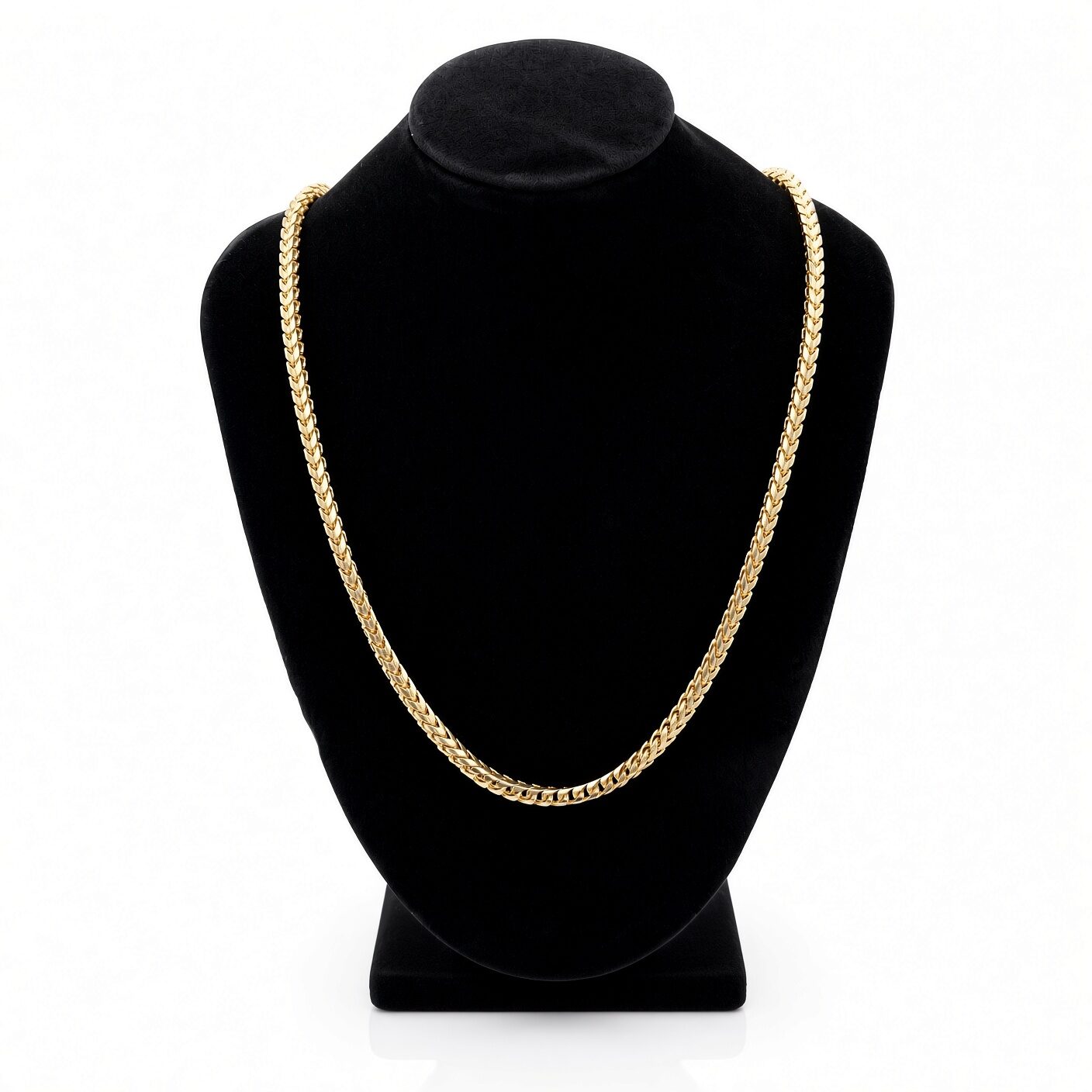
Weight, width and length are one equation
For a given link geometry, weight scales roughly with width squared and with length linearly. Doubling the width of a franco does not double the weight, it roughly quadruples it. This is why a 3.7 mm chain at 20 inches lands near 40 grams while a 2 mm at the same length is nowhere close.
Once you internalise that, you can sanity-check any listing instantly. A 5 mm 24-inch franco advertised at 30 grams is hollow, mislabelled, or not what it claims.
What a franco link is doing
A franco is a four-sided box-woven link where each element locks into its neighbours to produce a chain that is square in section and almost completely rigid against twisting. That geometry is why francos hang dead straight and do not kink, and why they take a pendant without rotating.
The cost of that construction is gold. More links, more material, more labour than a rope of equivalent appearance — which is exactly why a franco of a given width outweighs and outprices most alternatives.
Solid versus hollow: not a preference, a different product
Hollow chains are made from tubed gold. They look identical when new, weigh a third as much, and cost proportionally less. The problem is repair: a hollow link that kinks or crushes cannot be soldered without collapsing the tube, so a hollow chain that fails is usually finished.
A solid chain of the same width will cost several times more and can be repaired essentially forever. For anything you intend to wear daily or to keep, solid is the only sensible answer. Ask explicitly, in writing.
Working out the floor price yourself
14k gold is 58.5% pure. So a 41.85-gram 14k chain contains about 24.5 grams of fine gold. Divide the current spot price per troy ounce by 31.1035 to get the per-gram price, multiply by 24.5, and you have the intrinsic metal value — the number below which no honest seller will go, because they would do better melting it.
Do this before you negotiate on any plain gold chain. It converts a vague sense that a price is high or low into a specific figure, and it is the fastest way to spot both a bargain and a piece of gold-plated brass.
What to check on a used franco
Run it through your fingers and feel for a link that catches. Check the clasp and the two or three links either side of it, which take the most stress. Look for a karat stamp, usually near the clasp. And weigh it — a jeweller will do this in front of you in seconds, and it is the one measurement that settles most arguments.